
Kelowna • Okanagan • Roof Ventilation
ROOF
VENTILATION.
Proper ventilation is what stops an attic cooking your shingles from underneath in summer and growing frost on the roof deck in winter. Most of the roofs we look at don’t have enough.
All three from the BC Building Code, Article 9.19.1.2
Most Roofs We Look At Are Suffocating.
In summer, an under-vented attic runs far hotter than the air outside. That heat bakes your shingles from below, accelerating granule loss and cutting years off your roof’s life. Your air conditioning works overtime trying to cool a space that’s being heated from above.
In winter, warm, moist air from your living space rises into the attic and condenses on cold surfaces. Without proper ventilation to carry that moisture out, it soaks into your roof deck, grows mould on your trusses, and compresses your insulation — reducing its effectiveness exactly when you need it most.
Complete Ventilation Systems
Intake, Verified
Exhaust cannot pull what intake does not supply. Soffit venting at the eaves is where that air comes from, so we measure what your attic actually has against what the code asks for and tell you plainly if it is short — before any exhaust goes on that has nothing to draw from.
Ridge Ventilation
Continuous ridge vents let hot, moist air out along the whole length of the roof’s highest point.
Powered Ventilation
Solar-powered or hardwired attic fans for problem areas where passive ventilation isn’t sufficient. Thermostat-controlled for automatic operation during peak heat.
Blocked Intake
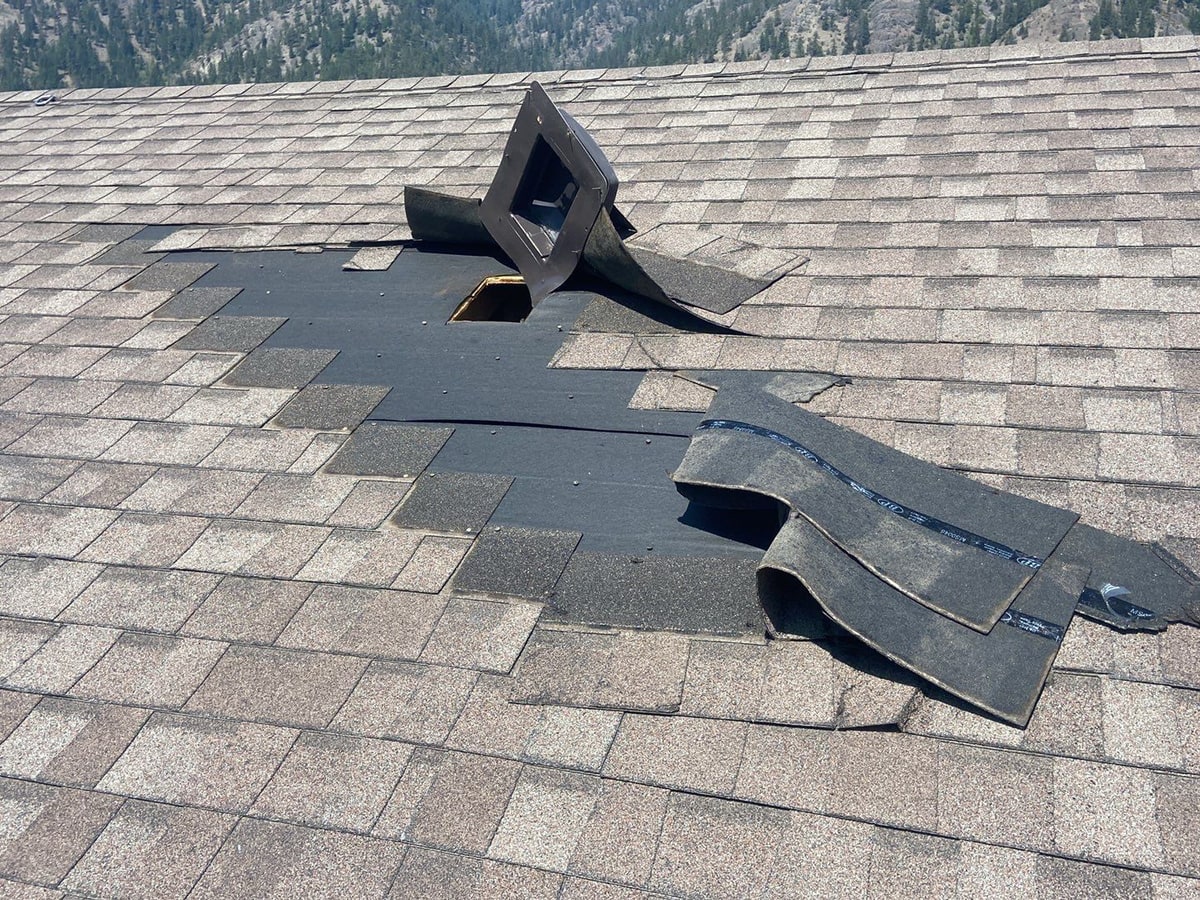
The most common fault we find: insulation packed hard into the eave, sealing off the very intake it was meant to sit clear of. The vents are there; the air is not. We find it, photograph it, and tell you what has to change before any exhaust will work.
Ventilation Calculation
We work out the vent area your attic needs from its ceiling area, the roof shape and the BC Building Code (9.19.1.2), then measure what is actually there. No guessing.
Year-Round Performance
Built for both ends of an Okanagan year: attic heat in summer, frost on the roof deck in winter.
The Balanced Airflow Principle
Outside air comes in low at the eaves and leaves high at the ridge. The two need to be about equal, or the air stalls.
Got Questions?
Let Your Roof Breathe.
It’ll Thank You for Decades.
We’ll inspect your current ventilation, calculate what your attic actually needs, and recommend the right system — all at no cost.
Request a Free EstimateNo obligation • Vent-area calculation included